Build a padel community
A 10-minute guide from PadelPush for community organisers and cohort managers — how to go from nobody to a group of players who play every week, and how to run the games that keep them.
Open the PDFA community is not a WhatsApp group with two hundred people in it. It's thirty people who play with each other every week.
Big groups are easy to build and nearly useless: everybody joins, nobody plays, and the chat fills up with "anyone for a game?" that nobody answers. What actually holds a group of players together is simpler and slower — a first game with the same few people, then a second one, then a slot that is theirs. People keep playing with the people they started with, and they bring their friends.
So this guide is about that order: a beginners' session to start, the places to find your first twenty players, turning a session into weekly games, living with the empty spots while a game fills, and the things that decide whether you're still doing this in three months — booking courts without fronting the money, pricing a game so it's worth your time, and keeping track of who has paid.
Running a single game? Read Organise Your Own Game — this one assumes you want more than one.
Start with a beginners' session
The players who stay are, overwhelmingly, the ones who started together. Not in a group chat — on a court, on the same morning, being shown the same things.
- —Teach, then play. The first half hour is the scoring, where to stand, the walls, and the one or two shots you need to keep a rally going. Then games, with you moving people round so everybody plays with everybody. The teaching is the point — a beginner who's never been shown the scoring doesn't come back, however friendly the game was.
- —You don't need to be a coach. If you play, you already know everything a first session needs: how the scoring works, where to stand, why the ball comes off the glass. Showing that is most of the value. Bring in a club coach only if you want more technique in it, or you'd rather not teach yourself — and then build their fee into the price.
- —Two courts, eight people, 90 minutes. Big enough to feel like an event, small enough that you learn every name. Three courts once it's working.
- —Say exactly who it's for. "Never played, or haven't played in years" brings both — and the lapsed players are often the ones who become your regulars fastest.
- —Send the first-game guide the day before. What to wear, what to bring, the rules in 90 seconds. It answers the questions people are too embarrassed to ask in a group.
How PadelPush handles it: put the session on from your cohort's Sessions tab — pick the club, the time and the number of places (four per court). People sign up through the link and land on your roster; everyone who signs up is in your cohort afterwards, so the next thing you post reaches them. Take the sign-ups there, not in the chat: a list of names in a WhatsApp thread can't tell you who's actually coming, and can't refill a drop.
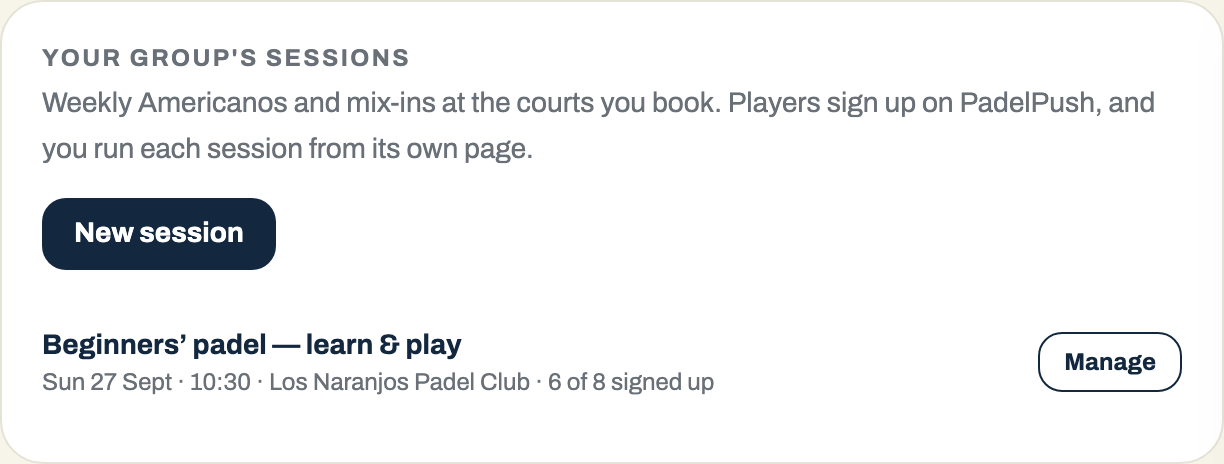
The session is the front door. Everything else in this guide is about what happens once people have walked through it.
Where to find your first twenty
They already exist. They're in groups that aren't about padel yet — the ones where people who've just moved somewhere ask where to meet people.
- —Facebook groups. Expats and newcomers in your city, the city's padel and sports groups, neighbourhood groups, parents' groups. Search "padel [city]", "[city] expats", "new in [city]".
- —WhatsApp and Telegram groups. Community groups, coworking spaces, language exchanges, running and cycling clubs, university and alumni groups. A lot of the active ones are on Telegram, especially for international communities.
- —Your own circles. Work, a Slack you're in, the gym. Most first sessions are half friends-of-friends.
- —On paper. Your cohort's Poster tab prints an A4 with a QR code that opens your group's page. Campus noticeboards, the club's reception desk, a café near the courts.

What to post
"Would anyone be interested in padel?" gets twenty likes and no players. Post one specific session — a date, a time, a place, a price, who it's for, and one link:
Beginners’ padel — Sunday 5 Oct, 10:30–12:00, Rackets Pro São Bento
Never played, or haven’t played in years? This is for you. Two courts, eight people. First half an hour we go through the scoring, where to stand and the two shots you need; then we play, and I swap people round so everyone gets a game.
Rackets provided if you don’t have one. €16 each, court included.
Spots here → padelpush.co/…
- —A photo of real people playing beats any graphic. After your first session, use that.
- —Read the group's rules, and ask the admin if promotion isn't allowed. "I run beginners' padel for newcomers — OK to post it here once a week?" gets a yes more often than not. Post as yourself, never as a page.
- —Once per session, not every day. The same post three times a week gets you muted.
- —Answer every comment, and answer it with the link. "How much?", "I've never played", "do I need a racket?" — reply warmly and point to the link. The link is where the spot is taken; the comments are where people decide.
- —Never add people to your group without asking. Post the link; let them join.
Let the cohort link do the collecting
Your cohort is the list that survives the group chat. It's who your people are, when they can play, and roughly what level — kept in one place instead of scrolled past.
- —Post the cohort link once, pin it, and put it in every post. It stays live: somebody who finds the group in three weeks' time joins without you doing anything. Give it a short address and a photo of your own people in Settings.
- —Save your WhatsApp group's invite link in Settings too, and everyone who joins is pointed at it — so the chat and the list grow together.
- —Somebody answered in a chat instead of the link? Add someone who answered in the chat puts them on the list by number; send them the link so they can say when they play.
- —Joining asks the level for you. If your cohort is a level group, a newcomer answers a short quiz first and lands where they'll enjoy it — you never have to tell anyone they're in the wrong game.
After the session: turn it into games
The 48 hours after a first session are when your group is warmest. Somebody will say "we should do this again" — have the next game already posted when they do.
- 1Read the grid. The Organise tab stacks up when your members said they can play and names the time to put a game on — and the fewest games that reach the most people.
- 2Put the games on from there. A match for one fixed time, or a blast offering two to four times when you're not sure. Either arrives already linked to your cohort.
- 3Post the game's link where your people talk — your WhatsApp group, the Telegram and Facebook groups you found them in. A link pasted into a chat where people already talk fills seats; a message sent on your behalf to people who aren't expecting it mostly doesn't. That isn't a guess — it's the clearest thing we've measured.
- 4Keep the same slot every week. "Tuesdays at 19:00" organises itself after a month — people hold it in their diaries before you've posted.
- 5Ask them back while they're still warm. The day after, post a photo in the group with the next game's link under it. The people who just played are the likeliest yeses you'll ever have.
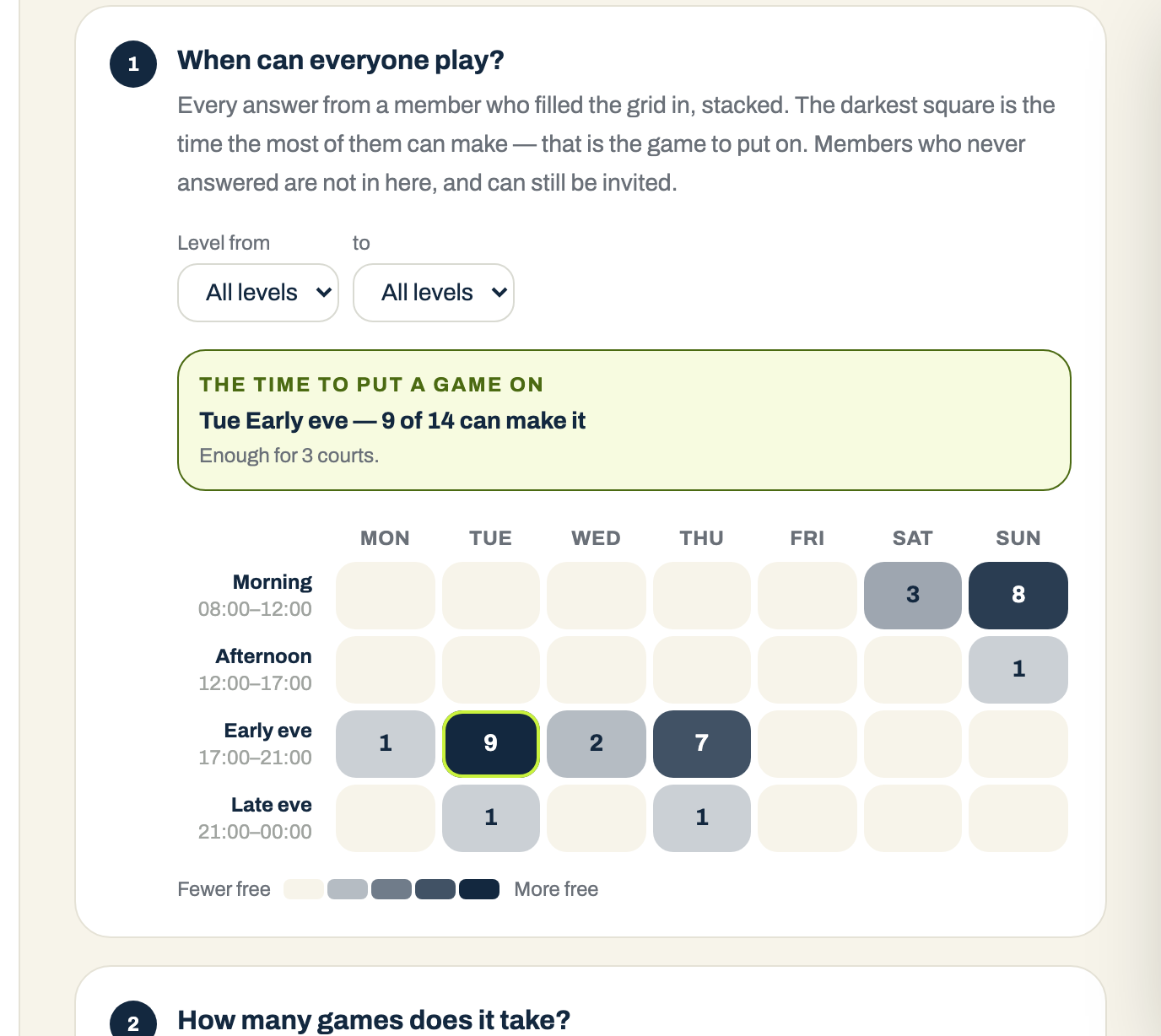
Your best growth isn't the next hundred members. It's the two or three regulars who'll help you run it.
Games you can't cover
When somebody asks for a game somewhere or at a time you don't run — "anyone near Cascais?" — look at the grid first. If enough of your members want it, that's your next game: put it on. If it's somewhere you'll never go, point them at the organise guide and let them run it. A game you'd never have run costs you nothing, and the players it brings in are one link away from yours.
Your cohort console also has a follow-up email that asks the people who've just played to put a game on themselves. That's your call, not a step — use it when there's more demand than you can run. Nothing sends until you press it.
When a game isn't filling
Every organiser knows the feeling: it's Wednesday, your Saturday game says 2 of 4, and you start wondering whether it's going to happen at all — and whether it's your fault. That feeling is normal, and most of the time it's wrong. Games fill late. A lot of people only decide in the last two or three days.
- —The cure is the group, not the game. Once you have enough people and you know when and where they like to play — which is exactly what the grid tells you — spots fill without much pushing. The early weeks are the anxious ones. They get easier as the group grows.
- —Put games where the people are. A game at the time the grid says is popular, at a club your members can get to, fills. A game at the time that suits only you is the one you'll be worrying about on Friday.
- —Give it a nudge, once. Re-post the link in the group with how many spots are left — "two spots left for Saturday 10:30" works better than the first post did. Or message a couple of members directly who said they play then.
- —Set yourself a cut-off, and keep it. Decide by the day before, while cancelling the court is still free — usually more than 24 hours before the game. Then either it is on, or you cancel the match and cancel the booking. Nobody pays, and players are told honestly that there weren't enough people.
The worst case is a cancelled game that cost nobody anything. That's a fine worst case. Cancelling one game now and then doesn't damage a group; cancelling late, or quietly, does.
Booking the court
Clubs take bookings three ways, and each one needs a different plan. Before your first booking at a new club, find out when the money is taken and until when you can cancel free. Those two answers decide everything else.
Playtomic
Most clubs charge your card the moment you book. The free-cancellation window — usually up to 24 hours before, but check, some are shorter and a few have none — is your safety net: book when you decide to run the game, and cancel free if it hasn't filled by the cut-off.
Tie Sports and other club systems
Some clubs book through Tie Sports or their own app instead. Same two questions, and don't assume the answers match Playtomic's — read the cancellation terms before you pay, not after.
Calling or messaging the club
The most underrated option. A lot of clubs will hold a court on a phone call or a WhatsApp message and take payment at the desk — especially off-peak, and especially once they know you. Nothing is at risk while the game fills.
Once you're bringing eight or twelve people a week, ask for a standing booking: the same courts, same time, every week. You're a regular customer with a group — clubs want that, and it's the easiest conversation you'll have with them.
Four things that catch people out
- —Booking windows. Some clubs only open bookings seven days ahead. Announce the game earlier, and book the minute the window opens.
- —Indoor and outdoor are different prices. Price the court you actually booked — the outdoor rate on an indoor court is the most common way an organiser ends up paying the difference themselves. Ask, and in summer, ask whether it's covered.
- —Several courts means booking them together. Neighbouring courts at the same time, so a session feels like one group and not three.
- —Get the court number in. On a PadelPush game, the confirmations go out with the court once you enter it — that's what tells people where to stand.
Paying in advance without fronting it
Whoever books a prepay court fronts the whole thing, and chasing people for their share is the fastest way to stop enjoying this. Three ways round it:
- —Collect before you book. Put your MB WAY, IBAN or payment link on the game; the amount rides on every player's confirmation.
- —Require payment to hold a spot. Unpaid spots are released after the hours you set and go back on offer — you're warned before it happens.
- —Never front a whole month. Once as a favour is fine. Every week is a subscription you didn't sign up for.
Pricing a game — and your fee
You set what each player pays and you collect all of it; PadelPush never touches the players' money. The price is a sum you do once per venue and slot:
| Court | The price of the booking you actually made — indoor or outdoor, peak or off-peak, 60 or 90 minutes. e.g. €52 for a court for 90 minutes |
|---|---|
| ÷ players | €52 ÷ 4 = €13.00 each. Two courts for a session of eight: the same sum, twice |
| + a coach, balls, rackets | Only if the session has them |
| + PadelPush’s fee | Per player, only on games that actually happen, and never on your own seat. Your figure is on your organiser page |
| + your time | Your call. It is your game and your price |
| = the price | Round it to a number people can send without thinking — €14, not €13.83 |
- —Give players one price, never the breakdown. The court, your time and the fee are your arithmetic, not theirs. Split it into parts and people start judging each part — and the part they question is yours. Nobody asks a club to itemise a court.
- —Say it in the post, never after. "€14 each" up front. Someone who says yes and then finds out what it costs says no next time.
- —Check your margin at each venue. The same price at two clubs can be a fair wage at one and nothing at the other, because the court costs differ. Do the sum per venue and per time of day.
- —Keep the price steady for the same slot. Your regulars notice changes more than they notice the number.
Your exact fee, how it's billed and what you're responsible for are on your organiser page and in the agreement.
Record who has paid
The money goes straight to you, so PadelPush can't see it arrive — you tell it. Every game with a price has a list of who owes what, on the Book & pay tab of the game. Keep it up to date; it's the only record there is.
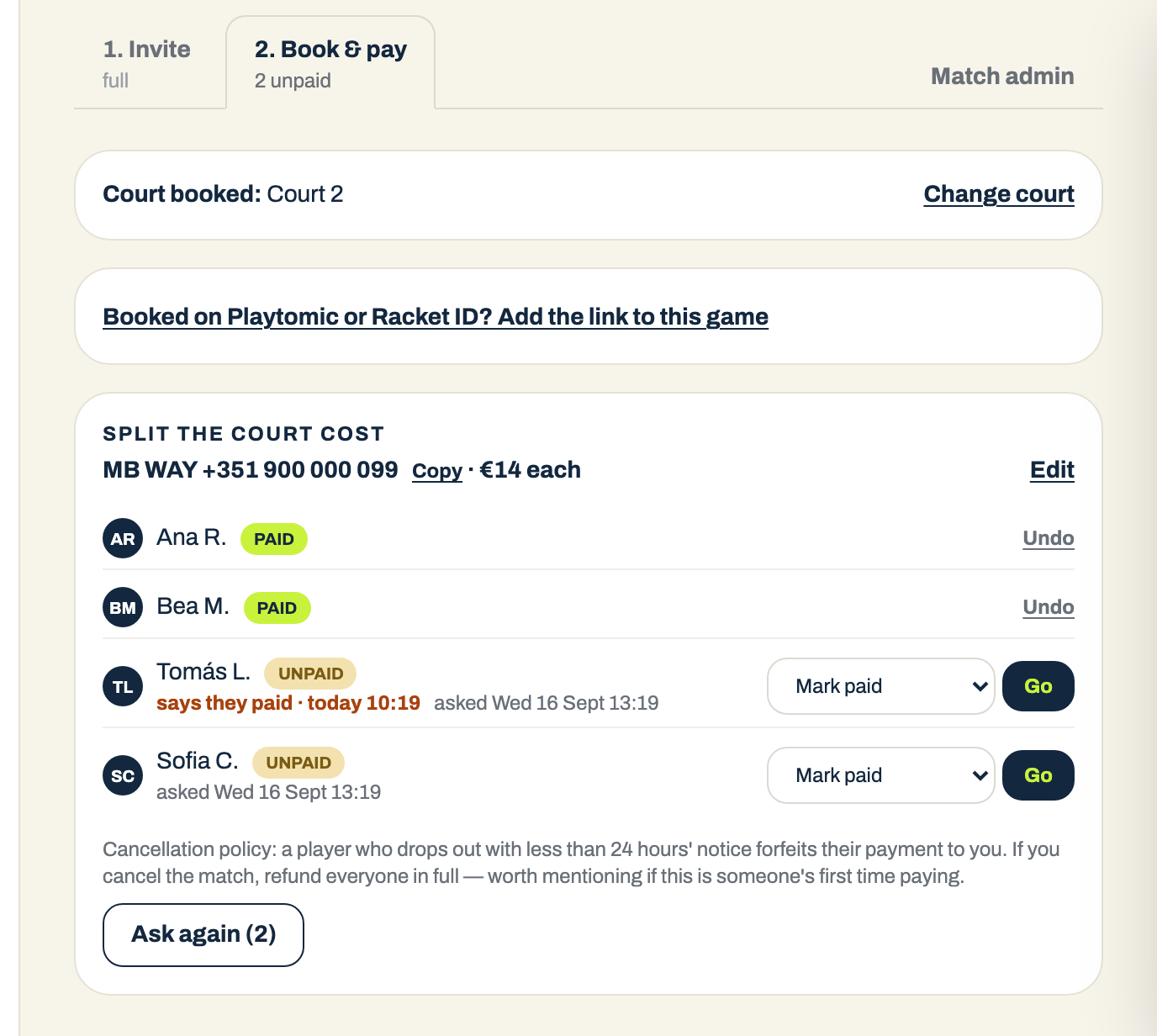
- —Mark people paid as the money lands. Check your MB WAY or bank, then choose Mark paid next to their name. Once a week isn't enough — do it as it comes in.
- —"Says they paid" is a question, not an answer. Players can tell you they've sent it. Check it actually arrived before you mark them.
- —This matters most if payment holds the spot. When you require payment, a spot you haven't marked looks unpaid — and gets released, even if the money is sitting in your account.
- —Paying at the desk? Mark them Pays on arrival and they stop being chased.
- —Let the reminder do the chasing. Ask again nudges everyone still unpaid, so you never have to write "just a reminder 🙏" in the group.
- —It's also your refund list. If someone drops and the spot refills, they get their money back. Inside 24 hours with no refill, their share is forfeited — that's the rule that makes the money you collected safe. If you cancel the game, refund everyone in full.
A week, once it's running
| Monday | Look at when your members said they can play. Post next week’s games — the links, not a poll — in your group and anywhere you found people |
|---|---|
| Tuesday evening | The one decision of the week: book the courts for games that are full or one short, and release anything that is nowhere near |
| Wednesday–Saturday | Mark payments as they arrive. Invites, chases, confirmations and drop-out refills run themselves |
| The day before | Last call on anything not full: re-post it, or cancel the game and the booking while cancelling is still free |
| Day of | You don’t have to be there. If you can be, go — see “Be there when you can” below |
| The day after | Post a photo in the group with next week’s link under it |
About an hour a week, most of it on Monday and Tuesday evening. If it's taking a lot more than that, something in the order above has slipped — usually booking before anyone has said yes, or chasing money by hand.
Be there when you can
You don't have to play in, or even turn up to, every game you organise. But going when you can makes a real difference.
- —People say yes to people. Somebody who has met you on court is far more likely to accept your next invite than somebody who has only seen your name on a link.
- —Newcomers need a face. Say hello to anyone new by name, introduce them, take a photo for the group.
- —You're the best cover for a no-show. Once in a while someone doesn't turn up and three people are standing on a court they've paid for. If you're there or nearby and can take the fourth spot, you've saved their evening — and they won't forget it.
Six habits of groups that last
- 1Keep the chat for games. Links, photos, results. A group that is all chatter gets muted, and then your next game isn't seen.
- 2Welcome every newcomer by name. In the chat and on court. The first game is where people decide whether this is their group.
- 3Be honest about level. A beginner in an intermediate game plays once. Say who a game is for in plain words.
- 4Keep people who started together playing together — and add one new face at a time. Groups that stay open grow; groups that close go stale.
- 5Be reliable. The game you said would happen, happens. One quietly cancelled game costs more trust than five good ones earn.
- 6Find a helper early. Somebody who can run Thursdays, take a second court, or cover when you're away — so the group doesn't stop when you do. Ask us and we'll add them as a second manager of your cohort.
Ready to start yours?
Already run a cohort? Everything above — sessions, the poster, the grid, the games — is in your cohort's console. Want to run games for people and be paid for it? Apply to be a community organiser.
Running a single game? Read the organise guide · New to padel? Read the first-game guide
PadelPush · weekly padel, organised · padelpush.co